Running now
Founder's reef tank pilot
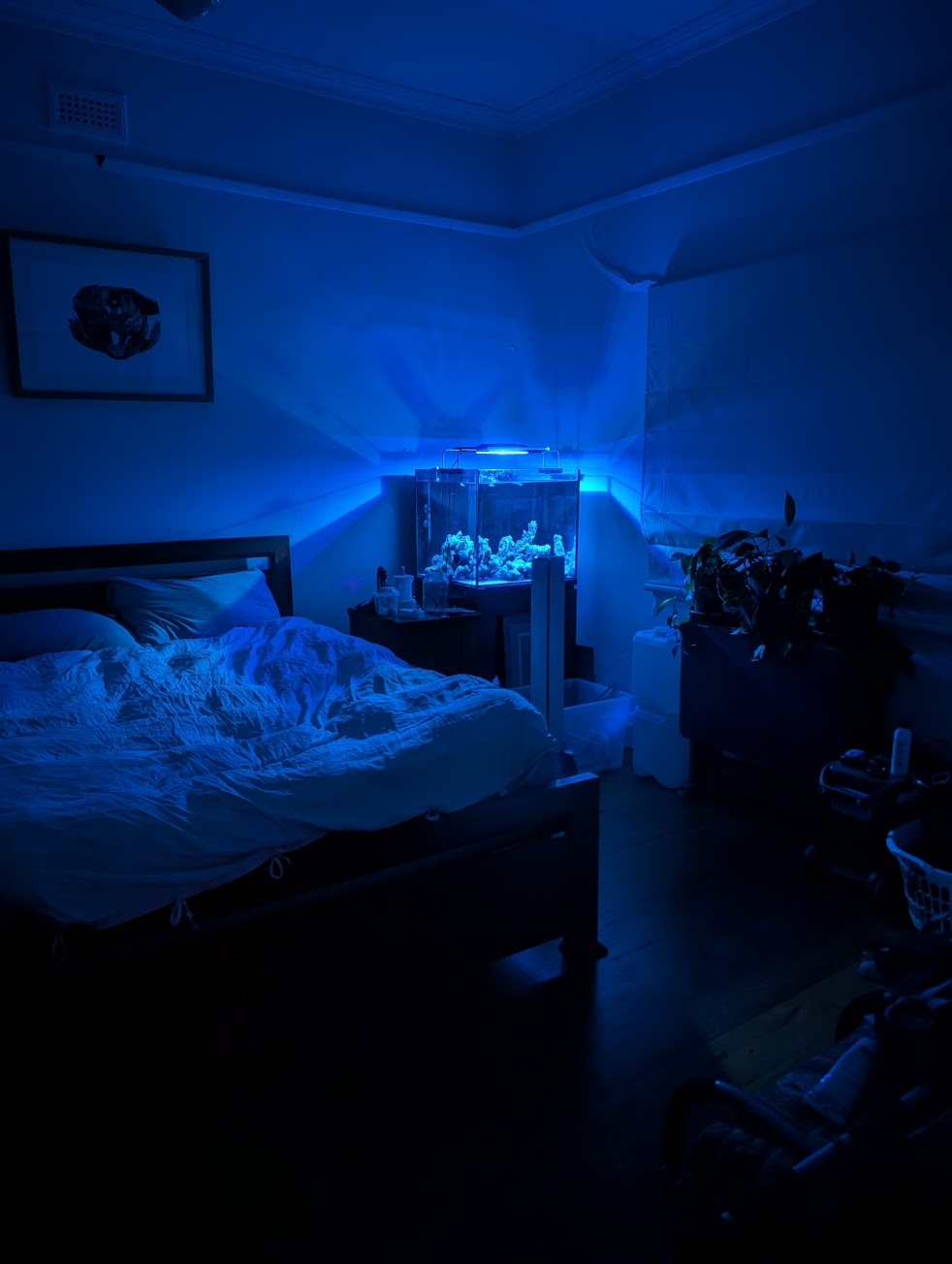
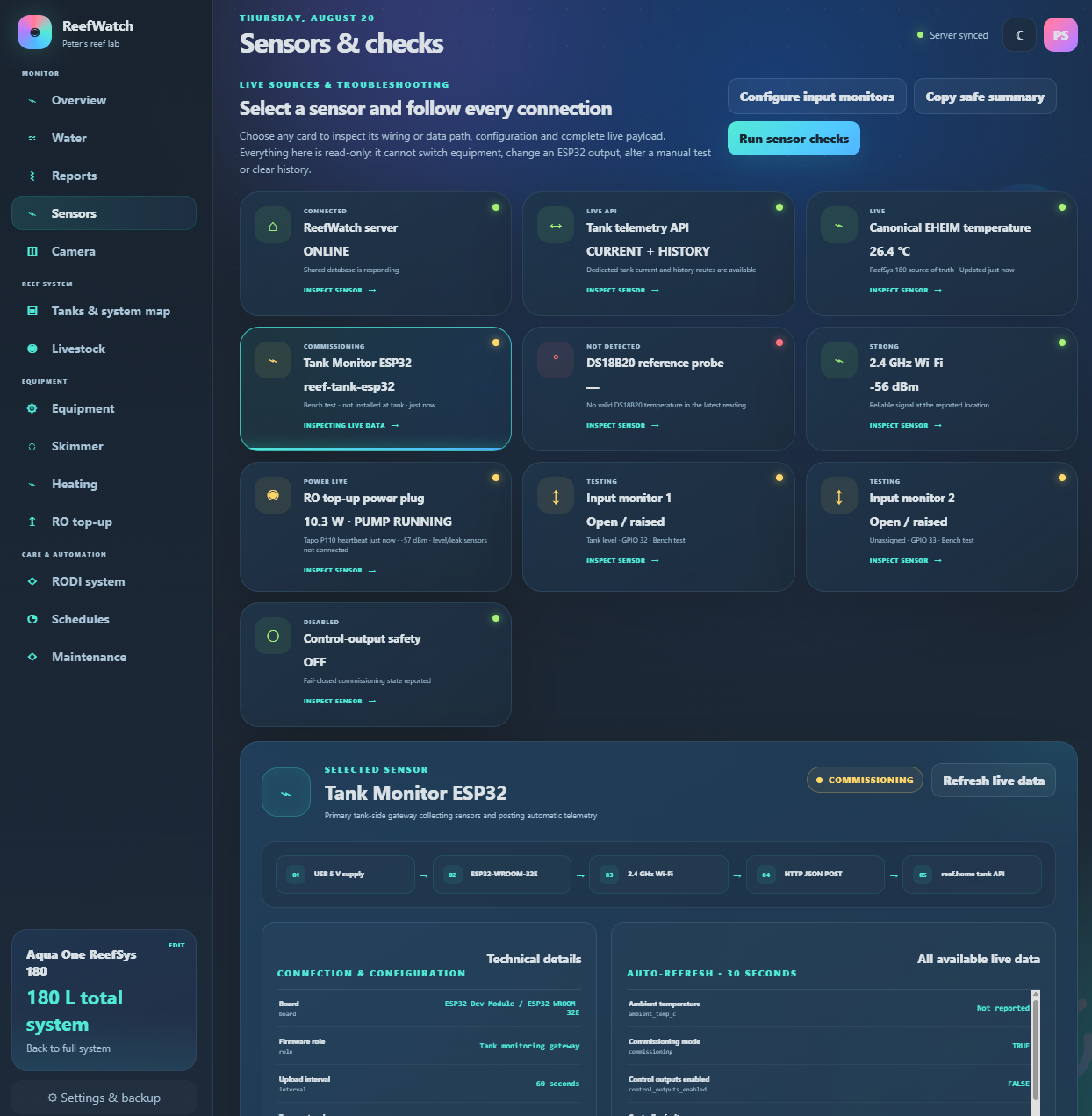
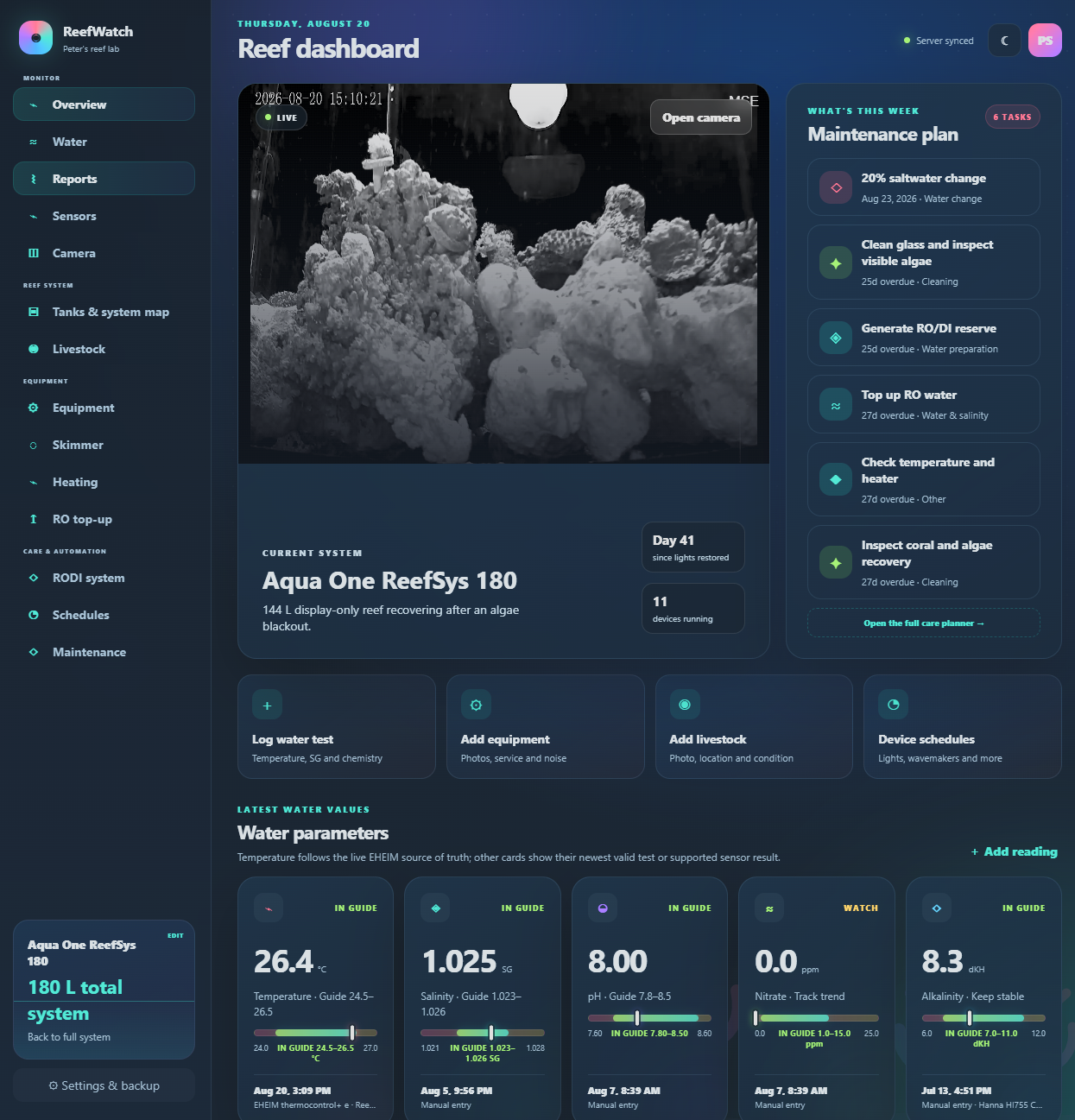
Peter Skliros is conducting the first pilot on his own reef system, building the initial longitudinal image, sensor, and intervention history.
AI early warning for reef aquariums
ReeferVision combines coral computer vision, continuous sensor telemetry, and offline edge safety into one operational model of the entire water system — so reef keepers can investigate drift before livestock shows the damage.
Why this exists
Testing is intermittent. A manual reading shows one moment, while dosing, evaporation, equipment, and livestock keep changing between tests.
The system is fragmented. Cameras, controllers, test results, maintenance notes, and alerts rarely share one operational picture.
Visible stress is a late signal. ReeferVision is designed to connect earlier changes in chemistry, equipment behaviour, and coral appearance.
You're testing at 11pm with a Hanna checker and a headlamp. Your alkalinity was drifting for two days before that test. The data was there. Nothing was reading it.
Current stage
The current pilot is focused on reliable sensor capture, repeatable camera observations, per-tank baselines, and whether the resulting information improves real maintenance decisions.
Running now
Peter Skliros is conducting the first pilot on his own reef system, building the initial longitudinal image, sensor, and intervention history.
Explore today
Interactive monitoring, graded-alert, workflow, and digital-twin concepts show how the system is intended to work end to end.
Next proof point
Expand beyond the founder's system, compare different reef configurations, measure alert usefulness, and test the installation workflow.
What you are seeing: dashboard values on this site are realistic sample data, not production customer telemetry. Model-performance claims will be published only after pilot validation.
What ReeferVision watches
Every reading feeds a per-tank baseline — so when something's wrong, the alert is about your tank, not a generic threshold someone else set.
The planned vision pipeline will score each colony for polyp extension, tissue colour shift, and recession against that tank's own photographic baseline. Founding-pilot images will determine which changes can be detected reliably.
planned · Vertex AI vision · longitudinal pilot dataset
Time-series models are designed to learn dosing rhythm, evaporation, and consumption rates, then flag meaningful off-trend behaviour. Pilot evaluation will measure warning time and false-alarm rate before performance is claimed.
planned · BigQuery ML baselines and forecasting
The edge hub is being designed to combine chemistry, level, flow, leak, and camera signals in one timeline. Cross-signal checks can then distinguish likely probe drift from genuine system change.
in development · edge capture + managed event pipeline
With explicit opt-in and enough validated systems, anonymised patterns could reveal shared equipment failures or consumable issues while keeping each tank's operating data isolated.
roadmap · opt-in cross-fleet anomaly research
A 3D flow-and-light map of your tank, built from your wavemaker positions, fixture, and camera view. Move a pump in the app and watch the flow map react — before you move it in the water.
interactive scape builder · PAR & flow estimates per spot
Acclimation timed by actual bag readings, water changes from a matched mix vat, placement recommendations per species. The hands-on moments where tanks go wrong — walked through, step by step.
live acclimation timer · per-species placement advice
Setup
The target experience pairs an edge hub with supported controllers and a calibrated camera module, without replacing monitoring hardware the owner already trusts.
planned · Wi-Fi or Ethernet · integration validation required
As history accumulates, the system learns daily chemistry swings, photoperiod response, dosing signatures, and each colony's normal appearance. The tank becomes its own reference.
design principle · per-tank baselines before fleet models
Drift, stress, or equipment anomalies trigger graded alerts — watch, warn, act — with the evidence right there: the trend chart, the camera frame, what probably caused it.
push · SMS · email · webhook
How it all works
No magic. Sensors and a camera at the tank, a managed cloud pipeline, models that learn your system, and a loop back down to the hardware when something needs doing.
Probes, level and flow sensors, leak sensors, and the camera all feed the ReeferVision hub at the tank. The hub buffers everything locally and runs the safety-critical rules itself — stop the return pump, lock out the ATO — so flood protection keeps working even when your internet doesn't.
edge device · local rule engine · works offline
Readings and camera frames travel encrypted to a managed ingestion service, land on an event backbone, and settle into a time-series warehouse — frames into object storage. Nothing for you to maintain, and it costs nearly nothing while a tank is quiet.
Cloud Run ingestion · Pub/Sub · BigQuery · Cloud Storage
Two kinds of models. A vision model scores each coral colony against your tank's own photographic history. Time-series models learn your daily pH swing, dosing rhythm, and evaporation curve, then forecast forward and flag anything off-trend — including equipment failure signatures like a heater starting to oscillate.
Vertex AI vision · BigQuery ML forecasting · per-tank baselines
Everything the models find gets turned into things you can act on: graded alerts (watch / warn / act) with the chart and camera frame attached, maintenance clocks, consumable forecasts, and a dashboard that syncs to your phone in real time.
Firebase sync · push notifications · evidence attached to every alert
For flood-risk and livestock-risk events, decisions flow back down to the hub: throttle the return pump, pause dosing, lock the top-off. The same safety rules are mirrored locally on the hub, so the protective actions never depend on a working connection.
cloud decisions → hub commands · safety mirrored at the edge
Live demo · sample data
A reef is a chain of processes — RO production, mixing, quarantine, top-off, the display itself. A crash can start anywhere in that chain. ReeferVision watches all of it as one system. Here's what a real setup looks like in the dashboard:
Where every drop starts. ReeferVision tracks TDS in and out, membrane pressure, and production rate — and learns when your DI resin or membrane is on the way out.
model note: membrane rejection normal · DI resin at ~78% capacity, replacement forecast 6–7 weeks · filtered tank covers ~5 days of top-off · waste tank empty reminder at 85%
Water change water, monitored while it mixes and brought to match the display before it ever touches your tank. No more guessing whether the batch is ready.
model note: batch matched to display, safe to transfer · salt consumption learned from your water-change rhythm · reorder reminder lands ~5 days before you'd run out
QT systems are unstable by design — small volume, no mature filtration, medicated water. The vision model scores corals in treatment, and the float valve gets cleanliness tracking, because a gunked-up QT float is how hospital tanks overflow.
watch item: trace ammonia rising since yesterday's feeding · suggested: small water change from matched mix vat (STN-02) · coral in treatment trending up from 79 over 8 days · float clean scheduled with next water change
The quiet failure point in most systems. ReeferVision tracks reservoir level, fill events, and pump behaviour — a stuck float valve looks very different from normal evaporation, and the model knows it.
model note: fill cadence matches learned evaporation curve · reservoir lasts ~8 more days · refill reminder scheduled
The engine room. Sock loading, skimmer behaviour, and return pump draw all have learned signatures — and every serviceable part in the system gets a maintenance clock, so cleans and seal replacements happen on schedule instead of after a failure.
model note: clocks aren't fixed timers — sock loading is read from the level differential across it, and the schedule adjusts to how your system actually fouls
Overflow restrictions, leaks, stuck floats, drain blockages — the failures that flood floors don't announce themselves. ReeferVision grades every alert so you know at a glance whether it can wait until you're home:
This is sample data, cycling live so you can see how the dashboard behaves — the numbers are realistic but not from a real tank (yet). Every station feeds the same per-system model, so an anomaly upstream (rising TDS, an off-spec mix batch) is connected to what it will mean downstream in the display.
Guided workflows
The moments where tanks actually go wrong are the hands-on ones — adding livestock, deciding where a coral goes. So the app walks you through them, using what it already knows about your water and your layout.
Tell the app what you're adding and it builds the acclimation plan from live readings — how long the bag floats is decided by the actual temperature difference, not a guess, and the drip rate is set from the salinity gap between bag and tank.
app note: phone buzzes when each step is actually ready · no more standing over the bag with a kitchen timer · full log saved to the livestock record
The app builds a flow-and-light map of your tank from your wavemaker positions, light fixture, and camera view — then recommends where a new coral should go based on what that species actually wants.
app note: the map updates when you move a pump or change the light schedule · PAR figures are model estimates — calibrate with a one-off PAR meter session for precision
Where this can scale
The first users provide dense feedback and diverse tank histories. The same monitoring loop can then serve operators responsible for many systems and higher-value livestock.
BEACHHEAD · 01
High-value, sensor-rich home systems where avoidable failures are painful and owners already invest in monitoring and automation.
EXPANSION · 02
A fleet view for teams maintaining tanks across customer sites, with earlier intervention and auditable maintenance workflows.
PLATFORM · 03
Multi-system operations where water chemistry, animal health, equipment performance, and intervention history must be understood together.
Founder
Founder · ReeferVision
Peter is building ReeferVision around a live pilot on his own reef tank. The first objective is practical: create a dependable history of what the system measured, what the corals looked like, what changed, and what action was taken.
That founder-operated pilot is the proving ground for the edge hardware, capture routines, per-tank baselines, and alert experience before ReeferVision expands to external pilot systems.
Founding pilot · Expressions of interest
ReeferVision is pre-launch. We are preparing a small founding pilot to validate the hardware, collect paired image and telemetry histories, and learn which alerts are genuinely useful. There is no paid subscription today and no model-performance claim hidden behind this form.
Collection notice: ReeferVision collects these details only to assess founding pilot interest. They are delivered to waitlist@reefervision.com.au through an email provider and retained in the receiving mailbox, not in a website database. Email that address to request access, correction, or deletion.
Or email waitlist@reefervision.com.au